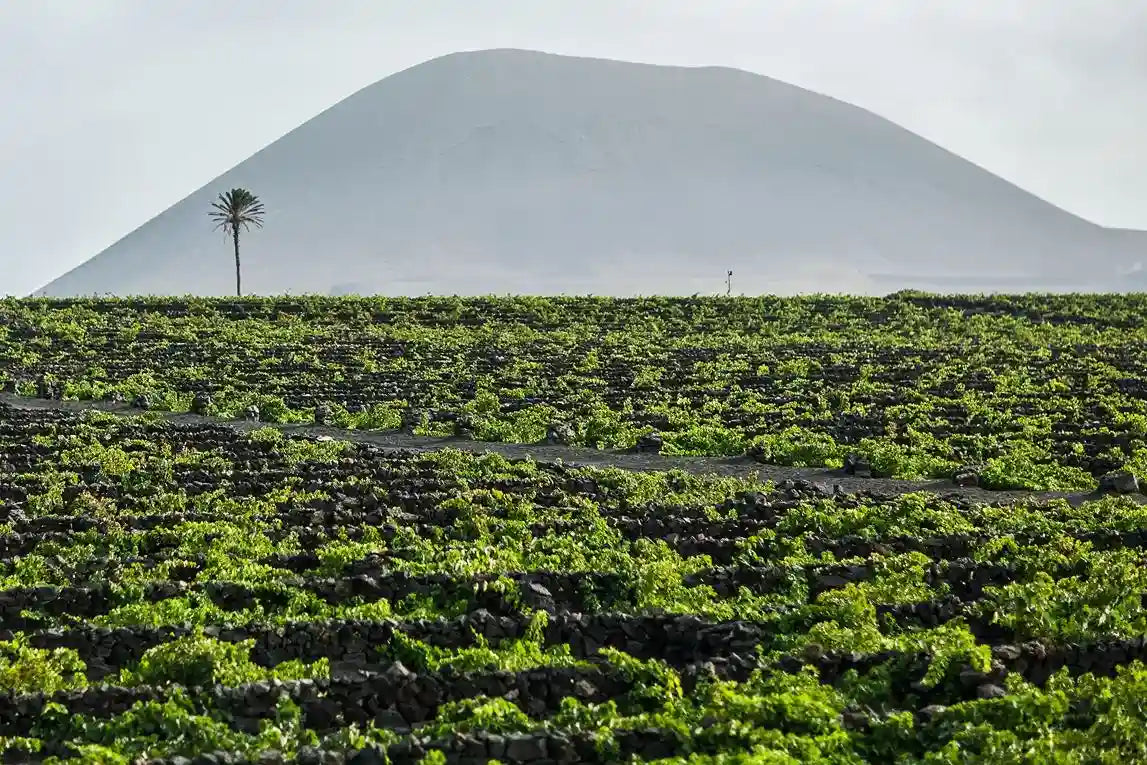
Climate is one of the most decisive factors in viticulture, and its influence on grape ripening largely defines the character of each wine. In this study, El Grifo analyzes the thermal integral for the year 2022 , applying the Winkler and Amerine methodology, a classic system developed in California that allows wine regions to be classified according to the accumulation of growing degree days throughout the growing season.
The thermal integral measures the sum of average daily temperatures above the vine's growth threshold (10 °C) during the period between March and July. This information allows us to determine the types of wines that can be produced in each area: from the fine, balanced wines of the cooler regions to the naturally sweet or high-alcohol wines of the warmer regions.
Comparative analysis places Lanzarote —with average data recorded between 2015 and 2024— in a thermal range equivalent to regions II and III of the Winkler classification , along with areas such as Ribera del Duero or Tinajo , where the warm climate and volcanic soils give Malvasía Volcánica its particular aromatic concentration and balance between sugar and acidity.
Understanding the evolution of the thermal integral over the years is key to anticipating the effects of climate change , adjusting harvest schedules, and selecting the varieties best suited to a changing environment. This study is part of the research and development program that the winery has maintained for decades, focused on sustainable and precision viticulture in extreme conditions.
Wine-growing regions (according to ITE):
-
Region I (< 1,371.8º): Ideal for high-quality dry wines.
E.g.: Laguardia, Lanzarote (average 2015–2024). -
Region II (1,371.8º – 1,649.6º): Good yield for common wines and possibility of fine wines.
E.g.: Ribera del Duero, Tinajo. -
Region III (1,649.6º – 1,926.8º): Warm climate. Ideal for sweet wines; not optimal for dry wines.
e.g.: I would do. -
Region IV (> 1,926.8º): Possible sweet and ordinary wines; variable acidity. Requires irrigation.
-
Region V (> 2,204.0º): Suitable for dessert and everyday wines if varieties with good acidity are used.